

Regenerative Urban Development: Why Sustainability and Impact are No Longer Enough

Updated: May 28
A quiet sense of separation. The future of the urban environment is regenerative, and it is about developing new potential, not merely buildings. Here we explain why sustainability and impact have reached their limits, and what comes next. Buildings stand on the ground without belonging to it. Streets channel water away as quickly as possible. Neighbours share walls but not stories. Trees are decorative, rivers are infrastructure, and people are users. We have spent decades trying to fix this with better tools: greener buildings, digital tools, more sophisticated metrics, and more ambitious impact targets. And yet, the cities we produce feel less alive, not more. That is not a failure of effort. It is a signal that the paradigms we have been working within have reached their limits. Regeneration is the new paradigm for the urban environment. It is the future. Our next step.
How we got here: from sustainability to regenerative urban development
The sustainability movement was born in the 1970s. The Club of Rome's Limits to Growth (1972), the first UN environmental conference in Stockholm, the oil crises, and a generation of pioneers who recognised the damage of unlimited extraction on the planet — together, they planted a seed that has shaped half a century of policy, design and finance. That seed grew. It brought us environmental legislation, energy codes, green building, ESG, climate agreements, and 'net zero' roadmaps. It moved sustainability from the margins to the boardroom. Much of what works in our cities today – cleaner air, better insulation, recycled materials, protected landscapes – we owe to that movement.
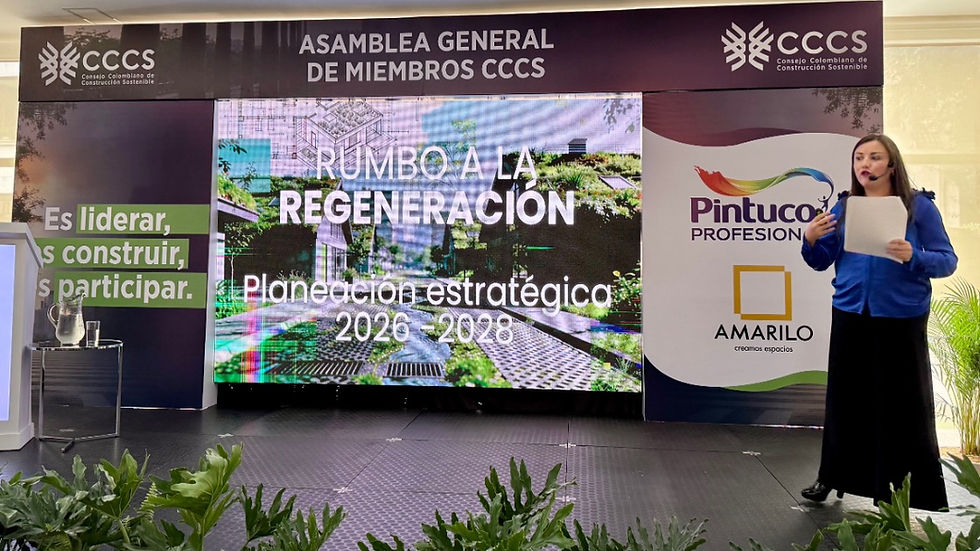
Within this historic movement, the Colombian Council for Sustainable Construction (CCCS) was born thanks to a visionary – Angélica M. Ospina Alvarado and five co-founders. Nineteen years ago, when the word "sustainability" was only just beginning to make its way into the corridors of the Colombian real estate sector, Alejandra was already convinced that we had to go beyond building a company; we had to think about the country and the future. She led the transformation of Grupo Contempo, turning it into a pioneer of sustainable construction in Colombia and the developer of some of the country's most emblematic LEED projects. As a co-founder of the CCCS, she brought the conviction that the sector needed a new paradigm. Eleven years ago, she was a negotiator on the Sustainable Development Goals (SDGs) and worked to translate sustainability initiatives into public policy. As a movement, the CCCS put the issue on the agenda. It was built collectively, brick by brick.
In parallel, Menno has been pushing the Dutch sustainable construction market to its next level since 2004. In 2020, he founded a global initiative called PropTech for Good and worked with 42 associations worldwide. The innovation was using technology in the real estate sector to do good. From 2021, he began his inner journey and became a leading voice for regeneration in the urban environment. Menno travelled to Colombia to deliver a keynote at the prestigious Construverde 2024. His call for regeneration was so impactful that, following it, the CCCS introduced regeneration into its 2026–2028 Strategic Plan.

We are pioneering the new paradigm: regeneration. And from the CCCS, we want to issue a powerful call to all leaders who feel the exhaustion of the old models and are ready to lead the future. As Menno and Alejandra say: "We are tired of optimising extraction. The time has come to regenerate life.
Sustainability asks us to do less harm. Impact raised the ambition
Impact raised the ambition: it asked us to deliver affordable housing at scale, avoid tonnes of CO₂, create jobs, and improve ESG scores. It introduced accountability. But the underlying logic remained the same: the city as a machine to be optimised, with cleaner outputs. Impact can be delivered to a place without being in relationship with it.
Separation is the root pattern in the urban environment
The root problem is not carbon. It is not density. It is not even capital. It is the structural disconnection of the urban environment from the living systems, communities and inner lives upon which it depends. Systems thinking offers a useful lens here: the Law of Three. In any system, transformation requires three forces in relationship: an active force, a receptive force, and a reconciling force that brings them into a new coherence. When all three are in right relationship, life flourishes. When they fall out of balance, the system fragments. In the modern city, that fragmentation manifests as separation, and it multiplies across three dimensions:
1. Separation from nature. The soil is sealed beneath concrete. Rainwater is channelled into pipes rather than allowed to soak in. Biodiversity is confined to the margins. The land becomes a site, not a partner.
2. Separation from one another. Zoning sorts us by income and function. Public space contracts or becomes transactional. Trust thins. Loneliness becomes a public health crisis, even in our densest neighbourhoods.
3. Separation from ourselves. Urban life rewards speed, performance and output. We lose touch with our bodies, our intuition, and our sense of place. Leaders make decisions under chronic stress, optimising spreadsheets while disconnected from the systems those spreadsheets describe. Burnout is not a personal failure; it is the predictable cost of leading a living world from a disembodied place.
Three separations. One pattern. Repeating across three scales.
Optimisation without life
This is why sustainability and impact, on their own, will not take us where we need to go. You can meet every ESG target and end up in a place where the soil is dead, the neighbours are strangers, and the leaders are exhausted. You can deliver high-impact projects within a worldview that still treats land and community as inputs. The next era of urbanism will not be defined by how cleverly we manage extraction. It will be defined by whether we are capable of creating places that are genuinely more alive than we found them. This does not mean 'we don't need sustainability or impact'. We do need them: they buy us the time to do restoration and regeneration well. But sustainability and impact alone are not enough.

Buildings as acupuncture points in regenerative urban development
Regeneration is that future. As Bill Reed (Principal of Regenesis Group) reminds us: 'There are no problems in nature, only potential.' That simple shift in stance changes everything. It is not a new set of tools bolted onto the old worldview; it is a different relationship with land, community and self. It treats the city as a living system, capable of healing and evolving when the right conditions are in place. This shift reframes the building itself. As Reed puts it: only living systems regenerate. A building cannot [listen to Bill at 15:00]. What a building can do is act as an acupuncture point within a living system: a precise intervention that unlocks flow, restores relationships, and catalyses the vitality of the place around it. That changes everything in how we design, finance and lead. The question is no longer 'how green is this asset?' but 'what does this place want to become, and how can this project serve?' The building becomes a means, not an end. The watershed, the neighbourhood and the community become the end. The outcome we are working towards is this: a capacity for a continuous field of potential, built through collaborative relationships with significant potential. Not a finished asset. Not a delivered KPI. A living field that continues to generate value – ecological, social, economic, cultural, intellectual, spiritual – long after project handover. This kind of work cannot be implemented through policy or certification alone. It must be led by developers, investors and municipal stewards who can read living systems, hold complexity, and make systemic decisions. Leaders who understand that the city they shape is also shaping them.
A call to the leaders who are ready
Half a century ago, a generation looked at the extractive economy and said: “This cannot continue.” They built sustainability. They brought us this far. Now it is our turn to take the next step – not by abandoning what they built, but by evolving it. If you feel the weariness of optimising metrics in systems that still feel lifeless… If you lead projects with measurable impact, and yet something is missing… If you sense there is a more complete paradigm waiting to be led… Then this call is for you. Sustainability taught us to do less harm. Impact taught us to measure more effectively. Regenerative urban development – the co-evolutionary capacity to grow with the places we shape – asks something deeper of us: that we return to a relationship with nature, with one another, and with ourselves. Place the needles well, and the buildings will flourish.
Join the Regenerative Era · REGEN101 Programme
A three-month journey for urban leaders – such as developers, investors, managers, and policy makers – ready to step into the regenerative paradigm. We start on 4 June 2026. Be part of the first cohort. Enrol here → www.cccs.org.co/academia-cursos/
About the authors:
Alejandra Torres Dromgold Founder, Academia Musas / President, Sistema B Colombia / Amazon bestselling author / Learn more and connect www.linkedin.com/in/alejatorresdromgold
Menno Lammers Wayfinder and Catalyst for regenerative urban futures. Learn more and connect www.linkedin.com/in/menno1977
Original source:


Thank you for such inspiring words; I feel grateful and happy that REGEN101 is taking place in Colombia. After searching for these initiatives around the world, it is a gift to cross paths with this one in my home country.